When you buy through links on our articles, Future and its syndication partners may earn a commission.

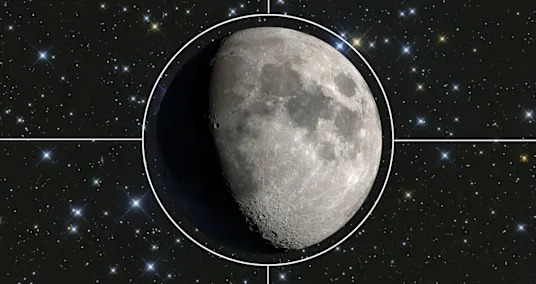
Look to the southern sky as darkness falls on March 27 to see the thickening form of the waxing gibbous moon glowing close to the stars of the Beehive Cluster (M44) at the heart of the constellation Cancer, the crab.
The 77%-lit moon will begin the night less than 2 degrees above the stars of the M44 open cluster, which plays host to roughly 1,000 gravitationally bound stars. The lunar disk will sweep right-to-left across the upper-stars of the Beehive over the course of the night, from the perspective of viewers in the northern hemisphere, at least, making its closest approach at 23:54 EDT (0354 GMT on March 28).
M44 appears as a small, milky patch of light to the naked eye on dark moonless nights. However, the glow of the nearby waxing moon on March 27 may pose a significant challenge to observing the open cluster as it rests close to Asellus Borealis and Asellus Australis, the central stars in the constellation Cancer.
A pair of binoculars can help reveal up to 20 of the cluster's brightest stars, while a 6-inch telescope will bring dozens more stars into view. The cluster formed around 600-700 million years ago, making it relatively young in the context of the 4.6 billion year history of our galaxy, according to NASA.
Turn your telescope on the moon to see the dark expanses of lunar mare scarring its ancient surface, where lakes of liquid lava flooded impact craters before hardening in the space environment. March 27 is also an excellent time to spot the shadowed forms of Copernicus and Tycho — two colossal impact craters surrounded by streaks of bright reflected material

Copernicus can be found close to the line separating night from day on the lunar surface, known as the terminator, while Tycho's 53-mile-wide (85-kilometer) impact basin is located far to the south, featuring a shadowed eastern rim and pronounced central peak.
Want to see the moon up close and witness the ancient light of star clusters shimmer before your eyes? Then be sure to check out our picks of the best telescopes and binoculars for exploring the night sky. While you're at it, why not take a peek at our guide to observing the lunar surface?
Editor's Note: If you captured an image of the moon with M44 and want to share it with Space.com's readers, then please e-mail your photo(s), comments, name and location to [email protected].
NEUESTE BEITRÄGE
- 1
 Climate engineering would alter the oceans, reshaping marine life – our new study examines each method’s risks14.01.2026
 - 2The 12 biggest space stories of 2025 — according to you27.12.2025
- 3Palestinian infant freezes to death in Gaza as Israel keeps blocking aid16.12.2025
- 4Amplifying Cash The executives: The Upsides and downsides of Various Ledgers30.06.2023
- 5New images reveal interstellar comet 3I/ATLAS approaching Earth08.12.2025


Ähnliche Artikel
- Private sector revives the climate disaster database Trump tried to squash08.01.2026
- Flu season is ramping up, and some experts are "pretty worried"22.12.2025
- Find the Force of The ability to understand anyone on a deeper level: Improving Mindfulness and Connections14.07.2023
- Top Fascinating Organic products: Which One Might You Want to Attempt?01.01.1
- NASA Artemis 2 astronauts to make historic moon flyby today. Here's what to expect hour by hour (timeline)06.04.2026
- Nestlé recalls infant formula in 49 countries. See list.09.01.2026
- Fact Check: Israeli Channel 13, Al Jazeera Did NOT Confirm Hezbollah Captured All Or Part Of Kiryat Shmona30.03.2026
- AstraZeneca to invest $2 billion as part of US manufacturing push21.11.2025
- Scientists dove hundreds of feet into the ocean and found creatures no human has ever seen. Our trash beat us there19.12.2025
- Best Exciting ride: Which One Rushes You the Most?01.01.1