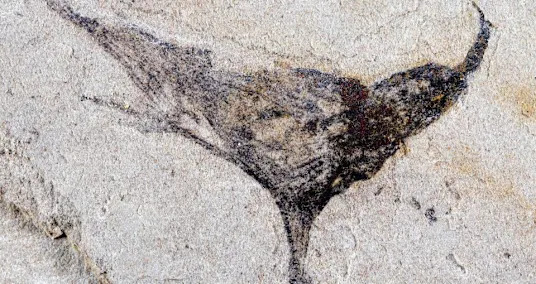
Goblet-shaped sea jelly relatives with miniature “arms.” A plump, legless creature resembling a sausage. Long, wormlike animals tipped with flat “holdfast” discs for anchoring to the seafloor.
Newfound fossils from a site in southwestern China, preserved in exquisite detail, offer a peek at a time in Earth’s distant past called the Ediacaran (635 million to 542 million years ago). The discovery suggests that complex animals — perhaps even ancestors of all vertebrates — were around millions of years earlier than once thought.
A few types of creatures were previously known from the Ediacaran, but the evolution of complex animal life has long been associated with the Cambrian, a later period from 542 million to 488 million years ago when fauna diversity and complexity were booming.
During the Cambrian explosion, animals with a wide range of bizarre structures and adaptations emerged. Some groups died out, but others eventually gave rise to modern animal groups such as chordates, crustaceans and mollusks. Because the Cambrian fossil record preserves so much animal diversity, scientists have long hypothesized that complex animal life didn’t yet exist during the Ediacaran.
However, the fossils from China tell a different story. These boneless organisms fossilized as biofilm — they were rapidly buried and compressed between layers of rock, leaving behind two-dimensional impressions of their organic tissues. Animals’ entire bodies were preserved. Feeding structures, delicate limbs and even traces of internal organs, which are typically lost during fossilization, are still visible.
For the first time, scientists have highly detailed examples of animals from the latter part of the Ediacaran. What an international team of researchers saw suggests that complex animal life arose around between 554 million and 539 million years ago — at least 4 million years before the Cambrian, they reported Thursday in the journal Science.

“We found what’s been long hoped for, which is a Cambrian-like preservation in the Ediacaran,” said study coauthor Ross Anderson, an associate professor of natural history at the University of Oxford in the United Kingdom. “We actually start to see some of the Cambrian-like organisms appearing in the Ediacaran when you have the right kind of preservation.”
A fossil trove
Researchers found the fossils at the Jiangchuan Biota fossil site in what’s now China’s Yunnan province. The site measures just 518 square feet (50 square meters), covering roughly the same area as a dozen king-size mattresses. Scientists from China and then the UK excavated approximately 700 fossils during multiple visits between 2022 and 2025. About 200 of these specimens represented animals, many measuring less than an inch (2.5 centimeters) long.
“I’m amazed that during so few field seasons they found that much,” said Jo Wolfe, an associate of the department of organismic and evolutionary biology at Harvard University who was not involved in the new research.
Six goblet-shaped specimens resembled a type of Ediacaran animal called Haootia quadriformis, known from fossils in Newfoundland dating to 565 million years ago. The wormlike fossils with “holdfast” discs — 56 fossils in all — were unlike any other ancient animal. Another type of animal resembled a segmented, tentacled sea creature called Herpetogaster, which was previously known only from the Cambrian. To Wolfe, that detail stood out.
“It’s a fairly unusual situation to have a mixture of Ediacaran-style and Cambrian-style organisms in a single locality,” she said. “It’s blurring the boundaries between what are Ediacaran and Cambrian life-forms.”
The presence of a preserved, visible gut in the sausage-shaped worm was also quite a rare sight in an Ediacaran fossil, as most fossils from this period are impressions of an organism’s body or movement, Wolfe added.

Many of the fossils demonstrate bilateral symmetry, in which the right and left sides of the body mirror each other. Most modern animals possess this trait, and the fossils provide abundant evidence that it evolved before the Cambrian.
“It really is a treasure trove of bilateral fossils, something that we did not have before,” Anderson said.
Perhaps the most intriguing fossils are the ones that potentially represent deuterostomes, the animal group that includes vertebrates, as well as starfish and sea urchins. Previously, the earliest known deuterostome fossils dated to the Cambrian, so this pushes back the emergence of the group to the Ediacaran.
“It shows that our vertebrate ancestors were around at this pretty early stage in animal evolution,” Anderson said. “I think that’s really exciting.”
However, classifying extinct animals that have never been seen before based on a handful of fossilized characters can be tricky, especially when scientists have only a single fossil to work from, Wolfe noted. In the crabs that she studies, different species often share features that represent convergent evolution — when the same characters evolve independently in different lineages — which only becomes apparent through analysis of modern animals’ DNA. For animal fossils that lack preserved DNA and don’t resemble anything alive today, teasing out their relationships to known animal groups can be significantly harder.
“The biggest difficulty with the Ediacaran organisms is that you have to hang your interpretation on very few characters,” she explained.
Much to discover
While the findings suggest that complex animals were already evolving by the end of the Ediacaran, the Cambrian explosion nonetheless still produced new and important animal phyla — the taxonomic classification below kingdom — such as mollusks and arthropods, and introduced unprecedented species diversification.
“In that sense, I still think the Cambrian is quite unique,” Anderson says. Still, the fossil finds support a growing body of evidence that the evolutionary boom associated with the Cambrian had an earlier start, “perhaps stretching back into the Ediacaran.”
This study is just the start of scientific investigation into these hundreds of fossils, Anderson added. Researchers will explore the conditions at Jiangchuan Biota that led to the fossils’ exceptional preservation, and plenty of questions remain about the biology, habits and interactions of these animals — among whom were our earliest evolutionary ancestors.
“What were their ecologies? Where were they living? What kinds of organisms were they? I think that will inform us a lot about our own ancestry. That’s something I’m quite excited about from this deposit.”
Mindy Weisberger is a science writer and media producer whose work has appeared in Live Science, Scientific American and How It Works magazine. She is the author of “Rise of the Zombie Bugs: The Surprising Science of Parasitic Mind-Control” (Hopkins Press).
Sign up for CNN’s Wonder Theory science newsletter. Explore the universe with news on fascinating discoveries, scientific advancements and more.
For more CNN news and newsletters create an account at CNN.com
NEUESTE BEITRÄGE
- 1
 Herzog, German Chancellor Merz discuss final Gaza hostage, Arrow 3 exchange in Jerusalem06.12.2025
 - 2Ukrainian foreign minister appeals for funds for drones16.11.2025
- 3Astronauts head home early after medical issue14.01.2026
- 4Startled Venezuelans express relief but also fear after Maduro arrest03.01.2026
- 52026 will be the year NASA astronauts fly around the moon again — if all goes to plan27.12.2025


Ähnliche Artikel
- BHP liable for 2015 Brazil mine disaster: UK court14.11.2025
- Sweet Taste? Candy Fulfills You06.06.2024
- 'We were genuinely astonished': This moss survived 9 months outside the International Space Station and could still grow on Earth22.11.2025
- NASA chief Jared Isaacman says Texas may get a moonship, not space shuttle Discovery31.12.2025
- Without evidence, CDC changes messaging on vaccines and autism20.11.2025
- Tributes pour in for MIT professor Nuno Loureiro amid unresolved shooting case18.12.2025
- Figure out How to Modify Your Pre-assembled Home for Greatest Solace and Stylish Allure19.10.2023
- Tech Devices 2023: The Most blazing Arrivals of the Year10.08.2023
- California is completely free of drought for the first time in 25 years09.01.2026
- Culinary Joys: Investigating Connoisseur Cooking at Home01.01.1


