Protests took place in Tel Aviv, Jerusalem, Haifa, and Beersheba, as a survey found broad but uneven support among Jewish Israelis for Operation Roaring Lion.
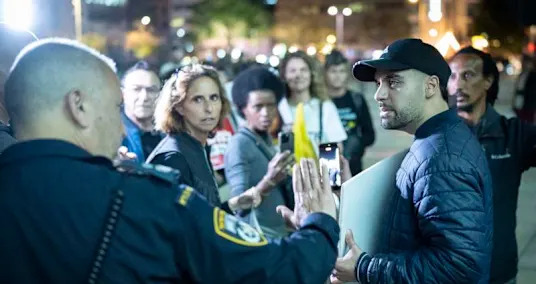
Israel Police arrested 21 anti-war protesters Saturday night as demonstrations against the conflict with Iran expanded in multiple cities despite restrictions on public gatherings.
Protests took place in Tel Aviv, Jerusalem, Haifa, and Beersheba, with hundreds of participants reported in Tel Aviv and Jerusalem and about 100 in Haifa, marking the largest turnout since weekly demonstrations began. Authorities said 13 people were arrested in Tel Aviv and eight in Haifa.
Police said the gatherings were not approved under Home Front Command regulations that ban events with more than 50 people. Officials said the increase in turnout followed calls by groups opposing the government to protest despite the restrictions.
“During a situation assessment that took place at the scene with a Home Front Command representative… it was clarified that there was a real risk to human life and accordingly, Yarkon [precinct] police commander Tzachi Sharabi ordered the gathering to be dispersed,” police said.
Hadash-Ta’al chairman Ayman Odeh, an Arab lawmaker involved in the protests, criticized the police response, calling officers fascists “in the service of the government” and saying they were afraid of “the heroic citizens who went out, despite everything, to make their voice heard.”

Survey shows broad, uneven support for war
The demonstrations come as a March 2026 survey by the Israel Democracy Institute found broad but uneven support among Jewish Israelis for Operation Roaring Lion. Support was strongest on the Right at 87% and about half on the Left.
The survey also found that Jewish and Arab respondents largely agreed that Iran’s resilience has been stronger than expected. Most Jewish respondents said Israeli society could sustain the campaign for up to one month, while 28% said as long as needed. Arab respondents were less optimistic about how long the public could endure the conflict.
A majority of Jewish respondents said Prime Minister Benjamin Netanyahu’s decision was driven by security considerations, while most Arab respondents viewed it as political.
NEUESTE BEITRÄGE
- 1
 A definitive Bike Standoff: Decision in favor of Your Number one Ride25.09.2023
 - 2IDF kills senior PIJ Gaza City Brigade cmdr. who infiltrated Kibbutz Nahal Oz on Oct. 701.12.2025
- 3The most effective method to Redesign the Sound Framework in Your Smash 1500.19.10.2023
- 4The Starbucks for Life game is back, along with your chance to win a 'Bearista' cold cup. Here's how to get your paws on one.08.12.2025
- 5Figure out How to Use the Experience of a Fender bender Legal counselor for Your Potential benefit19.10.2023


Ähnliche Artikel
- Moon memorial: Artemis 2 astronauts name lunar 'bright spot' after mission commander's late wife06.04.2026
- Far-right leader Le Pen to attend Brigitte Bardot's funeral30.12.2025
- South Carolina measles outbreak grows by nearly 100, spreads to North Carolina and Ohio09.01.2026
- The 12 biggest space stories of 2025 — according to you27.12.2025
- What loving-kindness meditation is and how to practice it in the new year29.12.2025
- My Excursion to a Better Way of life: Health Experiences22.09.2023
- Spots To Go Birdwatching All over the Planet06.06.2024
- 15 Outrageous Cosplay Outfits That Will Blow You Away04.12.2015
- The Latest: Fueling begins as NASA aims to send 1st crew to the moon in 53 years01.04.2026
- FACT FOCUS: Trump sows confusion on number of childhood vaccinations06.01.2026